



Many believe that fertility testing exists to check female reproductive health while male reproductive issues remain uncommon. The reality shows that sperm-related factors occur with equal frequency and their early testing helps reduce time requirements and stress levels and uncertainty related to their results. The common worry exists that one abnormal test result indicates the presence of a serious medical condition, which actually does not happen in most cases.
Here, we describe how fertility doctors evaluate male fertility through assessment methods, which produce results that convey specific information about male fertility. The main testing procedures assess sperm health through three measurements including sperm count, motility and morphology, and these results determine which treatment approaches to use. We illustrate that the process should be straightforward and practical while maintaining a high level of comfort.
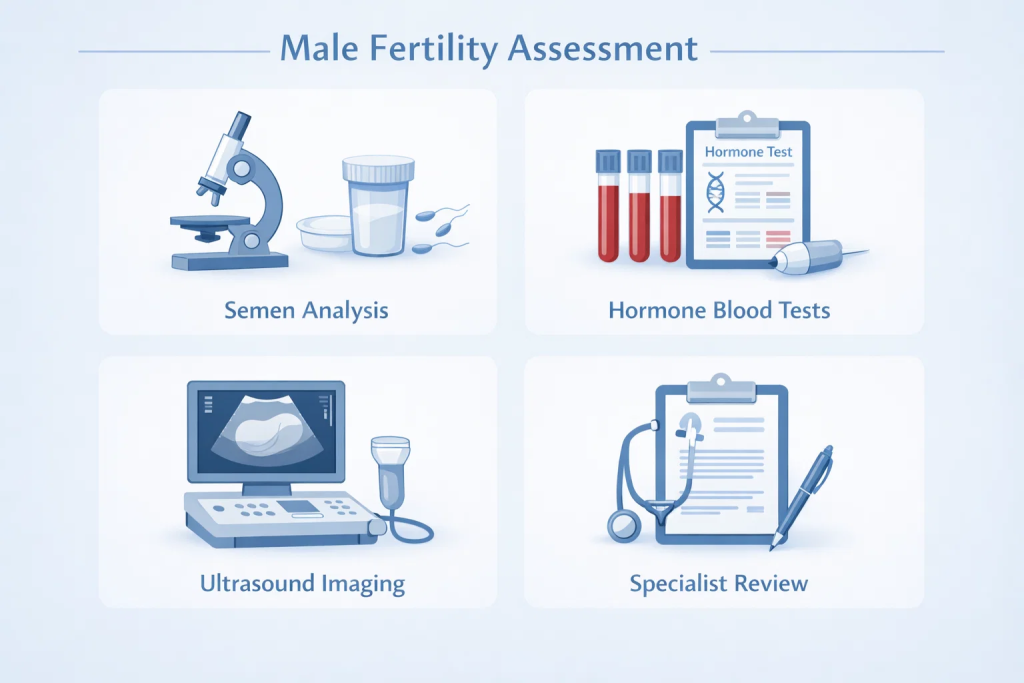
Why Male Fertility Testing Is an Essential First Step
Male fertility testing is often simpler and quicker than many people expect. It also provides valuable information early on, which helps avoid unnecessary delays or assumptions about where the issue might lie. From our experience, starting with male testing creates a clearer, more balanced picture of fertility from the outset.
Male factors contribute to infertility in a significant number of couples. Sometimes the cause is obvious. Often, it isn’t. Many men with no symptoms, no medical history, and normal sexual health still show sperm-related issues when tested. That’s why waiting too long can add frustration rather than answers.
Fertility doctors typically recommend male testing when:
- Pregnancy hasn’t happened after 6 to 12 months of trying
- There has been a previous unsuccessful IUI or IVF cycle
- There’s a history of surgery, infection, or hormone-related conditions
- A couple wants to plan treatment or fertility preservation proactively
Semen Analysis in Male Fertility Assessment
For most men, a semen analysis is the first and most important test used to assess fertility. It’s straightforward, non-invasive, and provides a large amount of useful information in a single step. From a clinical perspective, it helps us understand how sperm are being produced, how they move, and whether they’re likely to function as needed for conception.
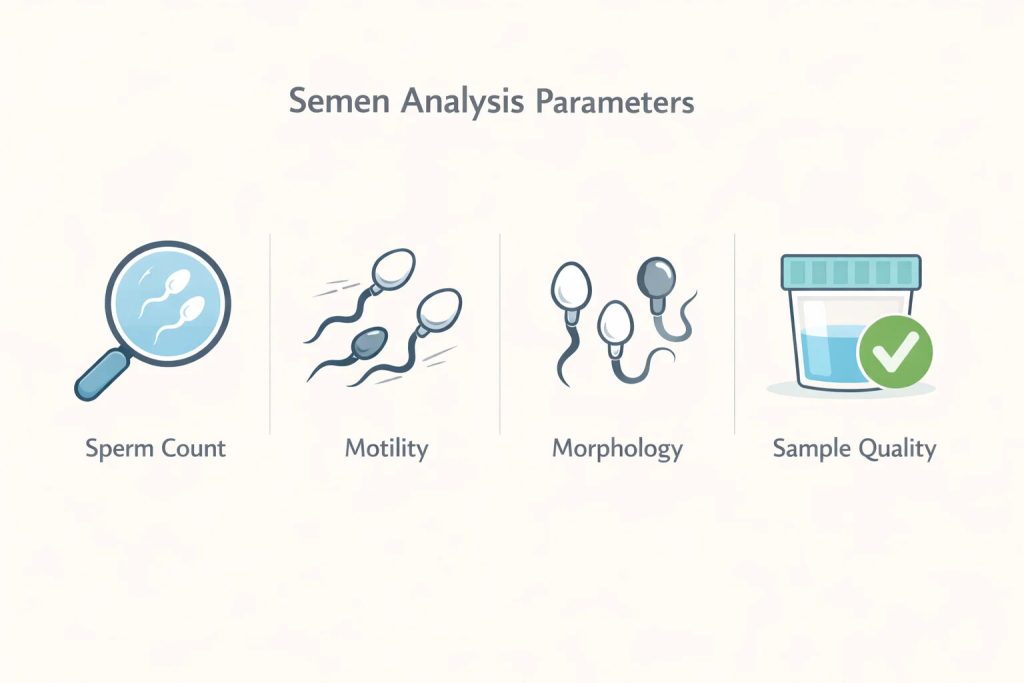
A standard semen analysis looks at several key parameters together, not in isolation. These include sperm concentration, movement, shape, and overall sample quality. Each of these factors plays a different role, and it’s the combination that matters most.
Understanding Key Sperm Parameters and What They Indicate
Once semen analysis results are available, fertility doctors look beyond the headline numbers. Each parameter answers a different question about how sperm function, and no single result is interpreted on its own.
Sperm Count
This refers to how many sperm are present in each milliliter of semen. A lower sperm count doesn’t automatically rule out natural conception, but it can reduce the odds. In some cases, the issue is temporary and improves on repeat testing. In others, consistently low numbers help doctors decide whether treatment support may be useful.
Very low counts, or the absence of sperm altogether, prompt further investigation to understand whether the issue relates to production, blockage, or hormonal signals.
Sperm Motility
Motility looks at how well sperm move, especially whether they swim forward with purpose. This matters because sperm need to travel through the reproductive tract to reach the egg. Poor motility can make this journey difficult, even when sperm count is normal.
Doctors usually focus on progressive motility, not just movement of any kind. Strong forward motion is more important than speed alone.
Sperm Morphology
Morphology assesses sperm shape, including the head, midpiece, and tail. Many people are surprised by how strict the criteria are. It’s common to see low percentages, even in men who go on to conceive without assistance.
What matters most is how morphology fits with the other results. When count and motility are healthy, morphology alone is often less concerning. When several parameters are affected together, it helps guide the next steps more clearly.
Additional Tests Fertility Doctors May Use
When semen analysis results raise questions, or when results don’t fully explain what’s happening, our fertility doctors may recommend further testing. This doesn’t mean something serious has been found. It simply helps narrow down the cause and avoid guessing.
Hormonal Testing
Sperm production depends on the central function of hormones in its process. Blood tests reveal the brain-to-testicular signal status. Doctors use testosterone FSH LH and sometimes prolactin tests to evaluate proper sperm production stimulation.
Genetic Testing
Genetic testing isn’t routine for everyone. It’s usually recommended when sperm counts are extremely low, or when no sperm are found in the ejaculate. In these cases, tests can identify chromosomal conditions or gene changes that affect sperm development.
Ultrasound and Physical Examination
A physical exam and scrotal ultrasound can reveal structural issues that don’t show up in lab results. One common example is varicocele, an enlargement of veins around the testicle that can interfere with temperature regulation and sperm production.
When Sperm Retrieval or Preservation Is Needed
Not every fertility journey follows the same path. When sperm are very low in number, difficult to obtain, or need to be preserved for future use, doctors may recommend additional options beyond standard testing.
Sperm Freezing
Sperm freezing is often chosen for practical or medical reasons. Some men want to preserve fertility before medical treatment. Others are planning IVF and want to secure a sample in advance. For some, freezing offers peace of mind, especially when sperm counts fluctuate. If this applies to you, our information on semen freezing in Bangkok explains how the process works and when it’s typically recommended.
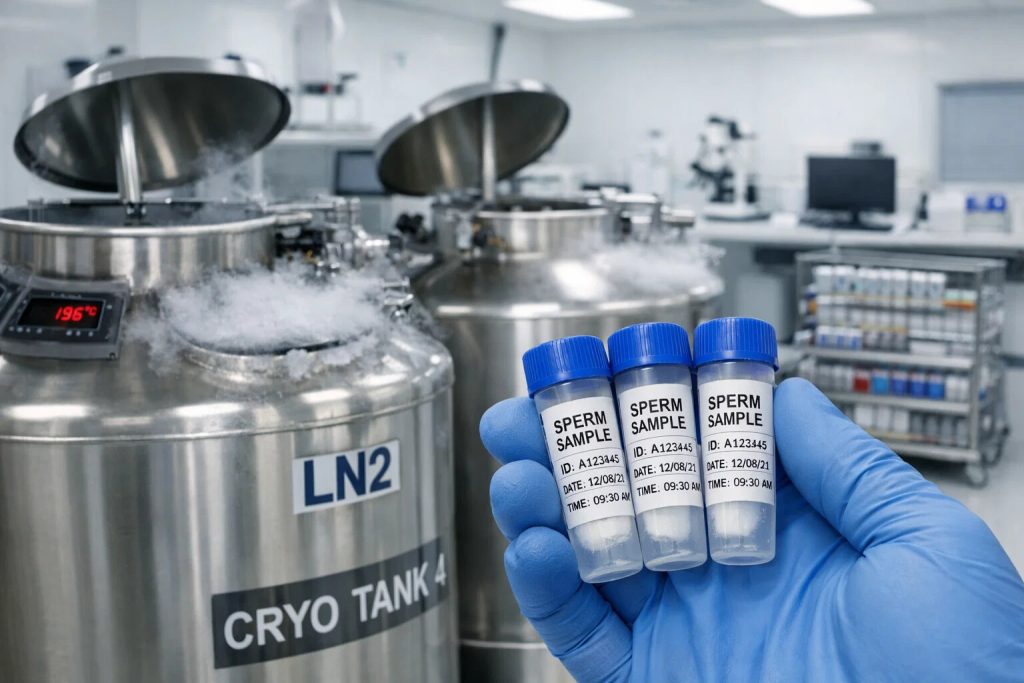
Frozen sperm can be safely stored for years and used later in IVF or ICSI treatment without reducing success rates.
Surgical Sperm Retrieval Options
In some cases, sperm are not present in the ejaculate at all. This doesn’t always mean sperm production has stopped. Sometimes there’s a blockage, or sperm are being produced in very small amounts within the testicular tissue.
Two commonly used procedures are:
- PESA, which retrieves sperm directly from the epididymis when a blockage is suspected
- TESE, which involves retrieving sperm from testicular tissue when production is limited
Bringing Clarity to Male Fertility Testing
Male fertility assessment is often more straightforward than people expect, and it plays a critical role in shaping an effective fertility plan. From our experience, the most important step is understanding that test results are not judgments. They are tools. Semen analysis, additional testing, and, when needed, sperm preservation or retrieval all help doctors identify the most appropriate path forward rather than leaving couples guessing.
If you’re navigating fertility testing or trying to make sense of results, at Lifespan Birth, we offer clear guidance and support at every stage. With the right information and a personalised approach, many male fertility challenges can be managed successfully.
What to Remember About Male Fertility Assessment
- Male fertility testing is an essential and routine part of fertility care
- Semen analysis is the foundation, but results are always interpreted together
- Sperm count, motility, and morphology each provide different insights
- Additional hormone, genetic, or imaging tests may clarify underlying causes
- Sperm freezing and retrieval options exist when standard samples aren’t sufficient
- Results guide treatment choices such as natural conception, IUI, IVF, or ICSI