


“Am I too old for IVF?” It is one of the most frequently asked and emotionally charged questions individuals consider when reflecting on fertility treatment. Some question whether they are beginning too soon or delaying too much. The timing rarely is crystal clear, particularly when age is frequently mentioned as the determining element.
Age significantly influences IVF success rates, primarily because it impacts egg quality and the likelihood of developing a healthy embryo. Simultaneously, it is not the sole element that is important. Overall well-being, past medical records, and the methods applied during therapy can all significantly affect results.
Coming to terms with the optimal age for IVF focuses less on pinpointing a specific figure and more on recognizing how fertility evolves through the years. In the upcoming sections, you’ll find variations in IVF success rates according to age, the biological changes that occur with aging, and what to expect realistically. You will also develop a better understanding of when to proceed and what choices might be open to you.
Key Summary
- The ideal age for IVF is typically before the mid-30s, when IVF success rates are generally highest
- IVF success rates decline with age, largely due to changes in egg quality and embryo development
- Outcomes vary widely based on individual health, fertility factors, and treatment approach
- At Lifespan Birth, first-transfer success rates can reach up to 93 percent, depending on age, embryo quality, and the use of advanced techniques such as PGT-A
- Speaking to one of our fertility specialists early can expand your options and improve overall outcomes
What Is the Ideal Age for IVF?
The optimal age for IVF is typically regarded as before the mid-30s, when egg quality and overall fertility capabilities are at their peak. At this point, IVF success rates are generally elevated, and the likelihood of producing healthy embryos is improved.
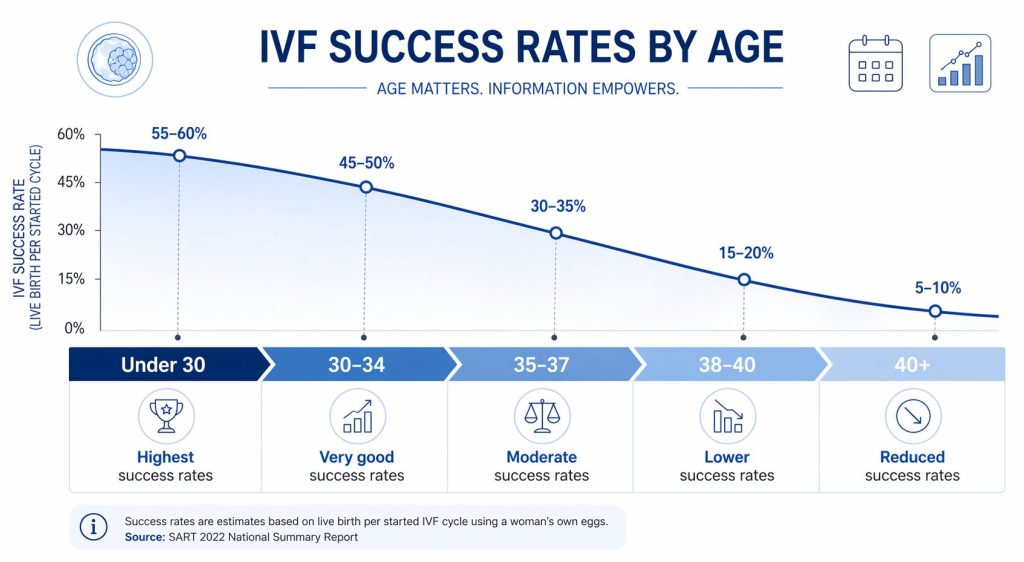
IVF success rates usually change gradually with age, which is why age is best understood as a trend rather than a fixed cutoff.
That being said, there isn’t a single “ideal” age that suits everyone. Fertility is affected by various biological and personal factors, making the optimal timing largely reliant on individual situations instead of a set figure.

From a biological perspective, two key elements shape outcomes:
- Egg quality, which affects embryo development and implantation
- Egg quantity, which reflects ovarian reserve and response to treatment
Practical factors also impact the timing of when a person decides to initiate IVF. These could involve relationship timing, career goals, financial arrangements, or past efforts to conceive naturally.
How Age Affects IVF Success Rates
Age impacts IVF success primarily due to changes in egg quality, rather than merely the quantity of eggs present. As one gets older, the chances of generating genetically sound embryos progressively decline, affecting fertilization, implantation, and pregnancy results.
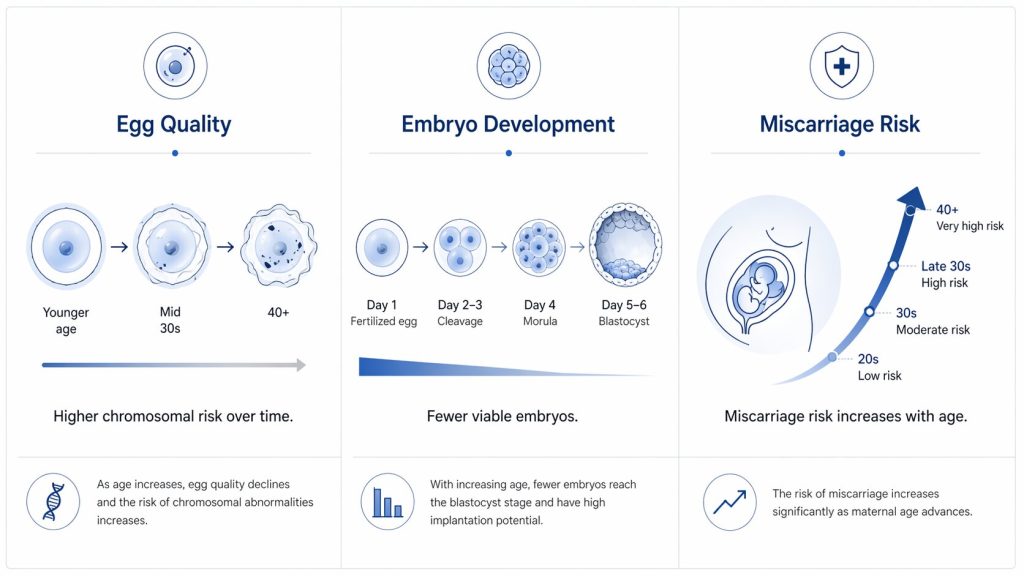
In the early 30s, a significant number of eggs continue to have a good likelihood of becoming viable embryos. During the mid to late 30s, understated changes start to emerge. Post-40, the change becomes clearer, with a reduced number of embryos achieving the stage required for successful transfer.
There are a few key biological changes behind this pattern:
-
Egg quality declines over time
Eggs are more likely to have chromosomal abnormalities, which can prevent implantation or lead to early loss -
Embryo development becomes less predictable
Even with successful fertilisation, fewer embryos may progress to a stage suitable for transfer -
Implantation rates may decrease
The chance of an embryo attaching to the uterus can reduce, even when embryos look healthy -
Miscarriage risk increases
This is closely linked to chromosomal issues rather than the IVF process itself
IVF Success Rates by Age Group
IVF success rates by age follow a clear pattern, but they are best understood as trends rather than fixed outcomes. Individual results vary based on health, diagnosis, and treatment approach, so these ranges should be used as a guide, not a prediction.
| Age Range | General Success Trends | Key Considerations |
| Under 30 | Highest success rates | Strong egg quality, high embryo potential |
| 30–34 | Very good success rates | Slight decline begins, still an optimal window |
| 35–37 | Moderate success rates | Noticeable drop in egg quality |
| 38–40 | Lower success rates | Fewer viable embryos, more variability |
| 40+ | Reduced success rates | Higher need for personalised strategies |
It is also important to look beyond age alone. Clinic expertise, lab quality, and the use of advanced techniques can significantly influence results. At our clinical practice, first-transfer success rates can reach up to 93 percent in certain cases, depending on factors such as age, embryo quality, and whether genetic screening is used.
Timing, Clarity, and Your Next Step
The ideal age for IVF is often discussed as a number, but in reality, it is a window that shifts depending on your individual fertility profile. Age influences IVF success rates, mainly through its impact on egg quality, yet it is only one part of a much broader picture. Many people achieve positive outcomes at different stages of life, especially when care is tailored to their needs.
If there is uncertainty, the most practical step is to gain clarity through proper assessment. Knowing your fertility status can turn guesswork into a clear plan. Clinics such as ours focus on combining clinical expertise with a supportive approach, helping patients navigate these decisions with confidence and realistic expectations.
What Matters Most When Deciding the Right Time for IVF
- The ideal age for IVF is generally earlier, but it is not a fixed or absolute cutoff
- IVF success rates decline with age, particularly after the mid-30s
- Egg quality is one of the most important factors influencing outcomes
- Advanced techniques and personalised treatment can improve success at different ages
- Early consultation can expand your options and support better planning
- IVF outcomes vary significantly between individuals, even within the same age group