


Ovarian hyperstimulation syndrome (OHSS) happens when the ovaries respond too strongly to the medication used to grow eggs during IVF or ICSI. Most cases are mild and settle within a week or two. Moderate to severe OHSS has historically affected roughly 1% to 5% of IVF cycles, according to the American Society for Reproductive Medicine (ASRM), and modern protocols are built around preventing it.
Because OHSS begins during the stimulation stage of the IVF process, we plan for it before your first injection. Here's who is most at risk, which symptoms need a same-day call, and how we keep OHSS from developing. For a wider view of treatment risks, see our guide to whether fertility treatments are safe.
What Is Ovarian Hyperstimulation Syndrome?
OHSS is a short-term condition in which stimulated ovaries enlarge and nearby blood vessels leak fluid into the abdomen. That fluid shift causes most of the symptoms people notice: bloating, fast weight gain and passing less urine.
The cause is hormonal. The hCG trigger injection given before retrieval, or the hCG from an early pregnancy, makes those blood vessels leakier. Early OHSS appears in the days after the trigger. Late OHSS develops if pregnancy happens that cycle and can take weeks to clear, according to MedlinePlus, because pregnancy hCG keeps rising.
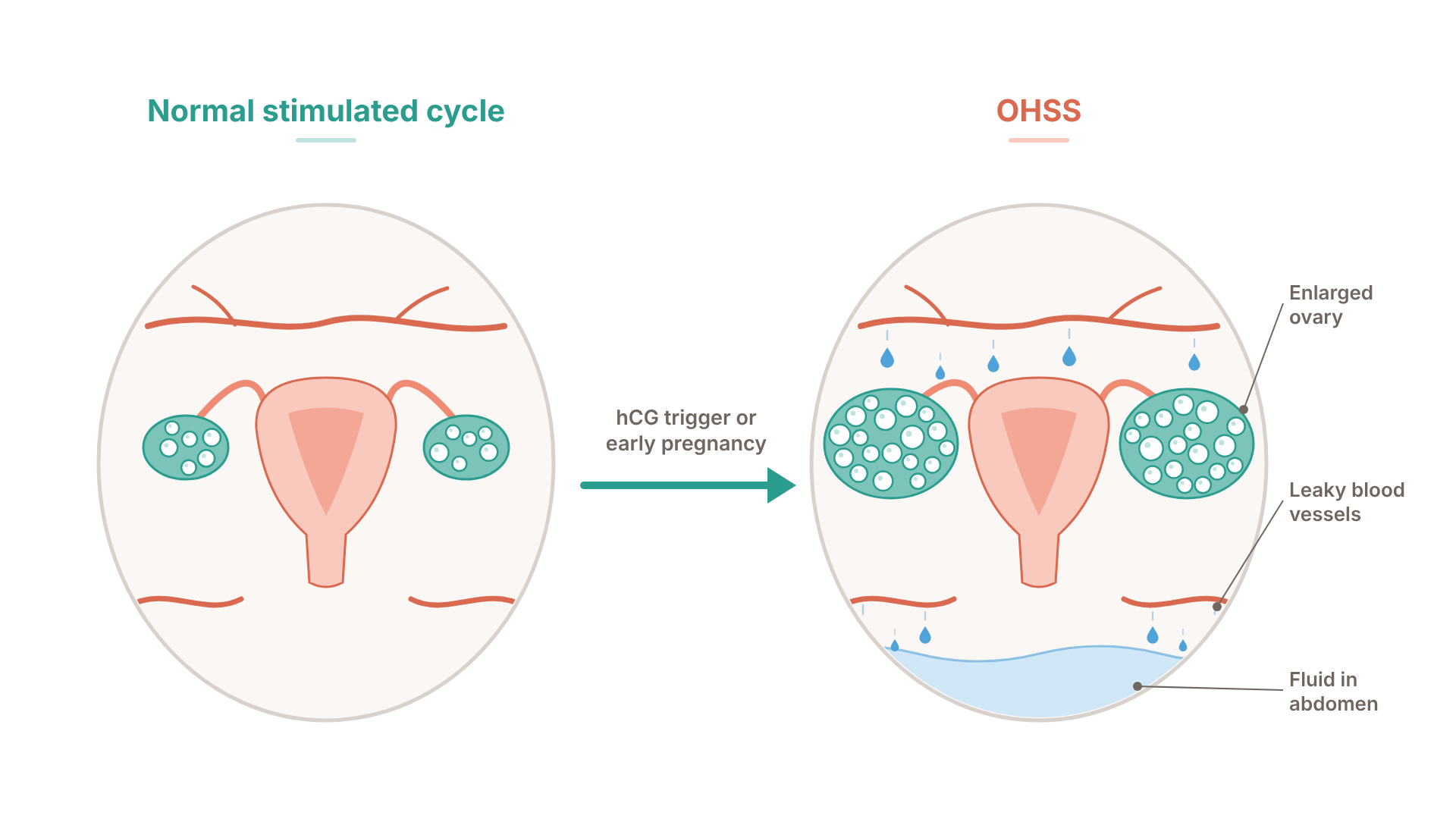
In OHSS, hormone signals cause fluid to leak from blood vessels into the abdomen, which drives bloating and rapid weight gain.
Side-by-side diagram comparing normally stimulated ovaries with enlarged ovaries in OHSS, showing fluid leaking into the abdomen.
Who Is at Higher Risk of OHSS?
OHSS risk is highest in patients whose ovaries respond strongly to stimulation, and much of that response can be predicted before treatment begins. The ASRM's 2023 OHSS guideline lists these risk factors:
Before stimulation
- Polycystic ovary syndrome (PCOS)
- A previous episode of OHSS
- A high antral follicle count (more than 24 on a baseline ultrasound)
- A high AMH level (above 3.4 ng/mL)
During stimulation
- More than 17 follicles of 10 mm or larger on trigger day
- Estradiol above 3,500 pg/mL at the time of the trigger
- More than 15 eggs retrieved
We check your AMH and antral follicle count before your first injection and use both to set your starting dose. If you look likely to respond strongly, you start on a gentler plan from day one.
That second list is why a very high egg count isn't automatically good news. Past a certain point, it signals a response that needs extra precautions.
OHSS Symptoms: What's Expected and When to Call Us Immediately
Mild bloating, aching and tiredness are normal after egg retrieval and should ease day by day. Symptoms that worsen instead, or anything in the middle or right-hand column below, need prompt attention.
| Expected after retrieval | Contact us the same day | Seek emergency care |
|---|---|---|
| Mild bloating that eases day by dayMild pelvic aching or crampingTirednessLight spotting from the retrieval | Bloating or swelling that keeps increasingGaining more than 2 lb (1 kg) in a dayNausea or vomiting that stops you keeping fluids downPassing noticeably less urineDizziness | Shortness of breath or trouble breathingChest painSevere abdominal painA painful, swollen legFainting |
Same-day symptoms based on MedlinePlus guidance on OHSS.
Early OHSS usually shows up within about a week of retrieval, and mild cases typically settle once your period starts. If you become pregnant, symptoms can return or persist, so the warning signs still apply during the two-week wait.
We ask every patient to weigh themselves at the same time each morning for the first week after retrieval and to message our team on WhatsApp if anything in the middle column appears.
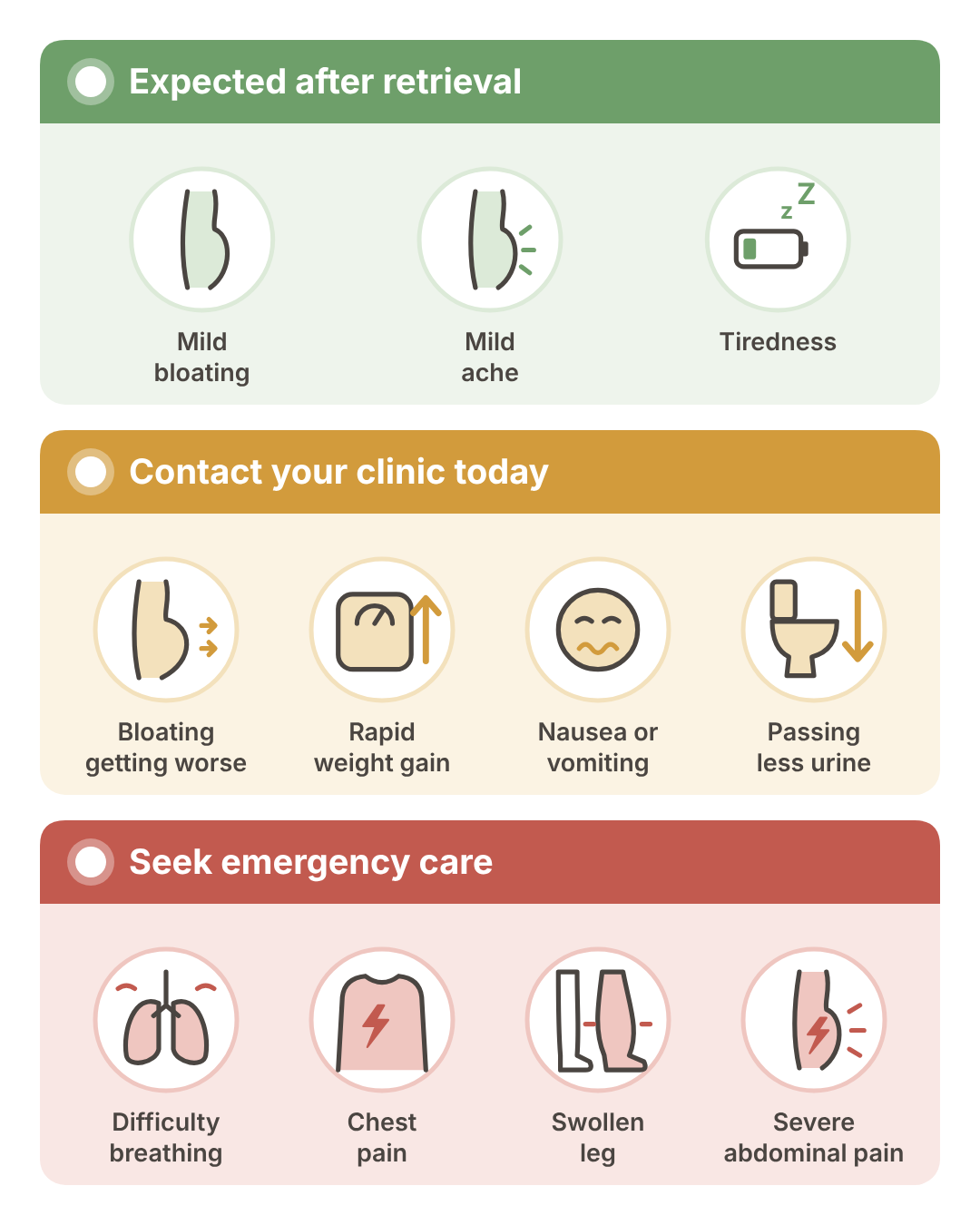
Not every symptom after egg retrieval is OHSS. This is how we suggest patients sort what they're feeling.
Traffic-light infographic sorting post-retrieval symptoms into expected, contact your clinic today, and seek emergency care.
How Clinics Prevent OHSS During IVF and ICSI
OHSS prevention is a series of decisions across the whole cycle. These are the measures recommended in the ASRM guideline, and how we apply them:
- A personalized starting dose. For a strong responder, a lower dose is the simplest prevention available.
- An antagonist protocol. The ASRM recommends a GnRH antagonist protocol over longer agonist protocols when OHSS is a concern. It's our standard approach for anyone with PCOS or a high AMH.
- Close monitoring. Scans and blood tests track follicle numbers and estradiol, so the dose can be adjusted before the trigger. Our clinical standards explain how this fits into our wider safety processes.
- Choosing the right trigger. When the response is high, we replace the standard hCG trigger with a GnRH agonist trigger, which the ASRM recommends as a first-line way to reduce moderate and severe OHSS.
- Cabergoline. For higher-risk patients, we prescribe a short course starting around trigger day to reduce the blood vessel leakiness behind OHSS symptoms.
- Freezing all embryos. When risk is still high after retrieval, no embryo is transferred that cycle.
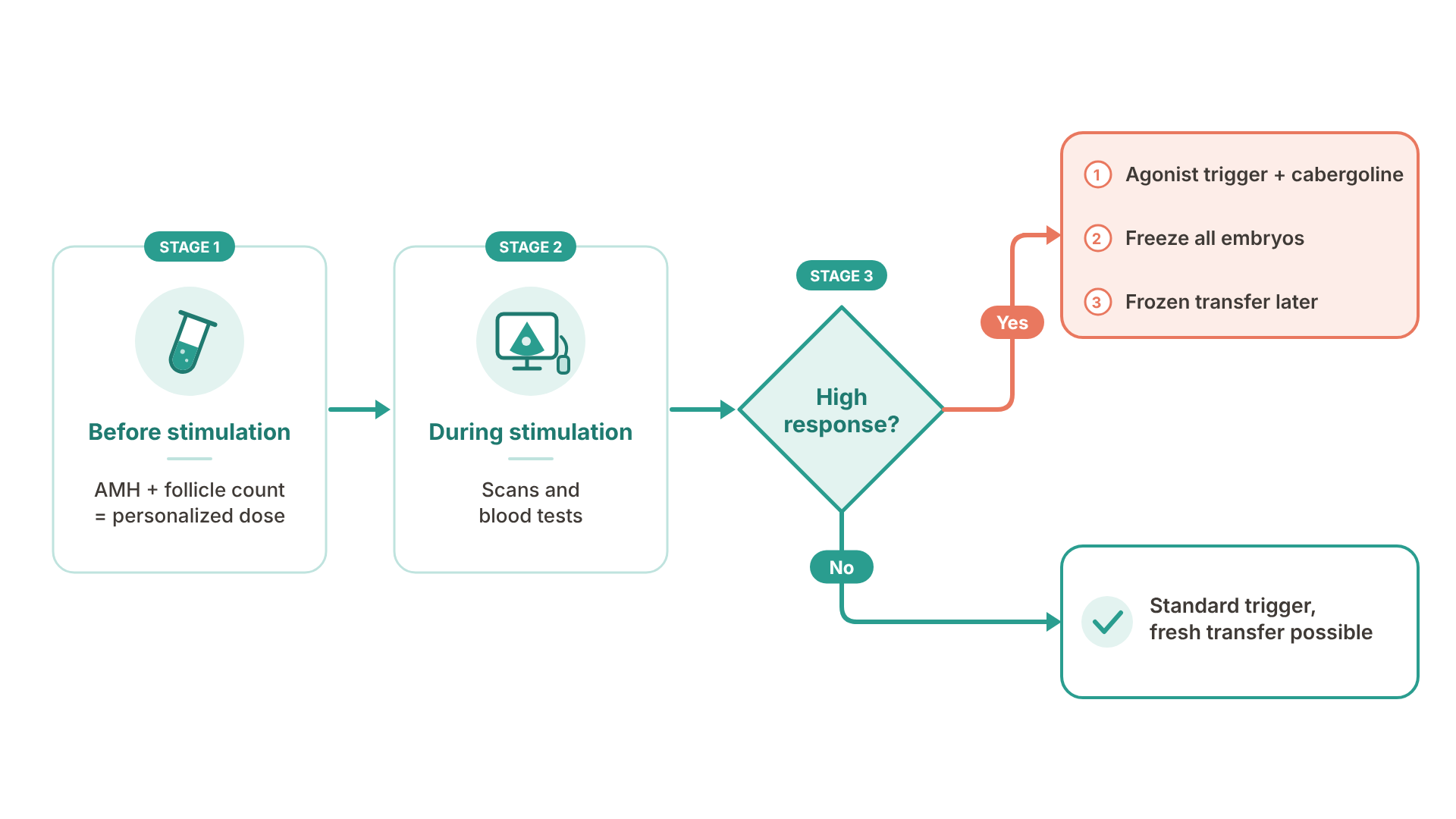
OHSS prevention is a series of decisions across the cycle, and the most important one comes at the trigger.
Flowchart showing OHSS prevention steps from dose planning and monitoring to choosing an agonist trigger and freezing all embryos for high responders.
When We Switch to a Freeze-All Cycle
When monitoring shows a high response, we freeze all suitable embryos and transfer one in a later cycle. Without a pregnancy in the stimulation cycle, there's no rising hCG to prolong or worsen OHSS.
We usually recommend a freeze-all cycle when one or more of these apply:
- Around 17 or more follicles are growing at the time of the trigger
- Estradiol is very high on trigger day
- More than 15 eggs are retrieved
- You already have OHSS symptoms at retrieval
- A GnRH agonist trigger was used
In a randomized trial of 2,157 women published in the New England Journal of Medicine, OHSS occurred in 0.6% of those with a frozen transfer versus 2.0% with a fresh transfer, with similar live birth rates.
There are trade-offs. Freeze-all adds at least one cycle before transfer, which can mean a second trip to Bangkok. And because the ASRM links an agonist trigger followed by a fresh transfer to lower live birth rates, the two usually go together.
A frozen embryo transfer (FET) uses those same embryos, timed for when your body is ready. For embryos you don't use, see what happens to unused embryos after IVF.
Planning Travel Around OHSS Risk
If you're traveling for treatment, stay near the clinic for several days after retrieval, when early OHSS usually appears. Long flights add dehydration and hours of sitting still, which can make OHSS harder to manage and raise blood clot risk.
We advise international patients not to book a return flight until we've checked in with them after retrieval. If we've identified you as a high responder, we usually recommend staying in Bangkok for at least five to seven days after retrieval.
What Matters Most If You're Concerned About OHSS
- Your OHSS risk can be estimated before stimulation starts.
- A high egg count calls for extra precautions. It isn't automatically good news.
- Bloating that keeps increasing, rapid weight gain or passing less urine needs a same-day call. Breathing difficulty or chest pain needs emergency care.
- A freeze-all cycle is a safety decision. Your embryos aren't lost, only waiting.
- When comparing clinics, ask which trigger they use for high responders and when they freeze all embryos.
At Lifespan Birth, OHSS prevention is built into how we plan every stimulation cycle, from your first blood test to the day of your transfer.