


An IVF cycle takes about four to six weeks from your baseline scan to your pregnancy test. The hands-on part, from the first stimulation injection to embryo transfer, is closer to three weeks, which is the figure on our IVF process page. Tests beforehand, or a decision to freeze embryos, can add weeks to the calendar. The NHS gives a similar range of three to six weeks for a full cycle.
For international patients, the more useful number is usually shorter: most people need to be in Bangkok for two to three weeks. Here is how the IVF timeline breaks down, week by week.
The IVF Timeline at a Glance
Every cycle follows the same sequence, though the exact days depend on how your body responds. The timeline is the same for ICSI, the fertilization method we recommend for most patients.
| Phase | Typical length | Where it happens |
|---|---|---|
| Tests and consultation | 2 to 8 weeks before | At home (remote) |
| Cycle start and baseline scan | Day 2 or 3 of your period | At home or in Bangkok |
| Ovarian stimulation | 8 to 14 days | Bangkok (monitoring) |
| Trigger shot to egg retrieval | 34 to 36 hours | Bangkok |
| Fertilization and embryo culture | 3 to 5 days | Bangkok lab |
| Fresh embryo transfer | Day 3 or 5 after retrieval | Bangkok |
| Two-week wait and pregnancy test | 10 to 14 days after transfer | At home or in Bangkok |
Stimulation and retrieval timing: ASRM ReproductiveFacts ART booklet. Culture and test timing: Lifespan Birth IVF process.
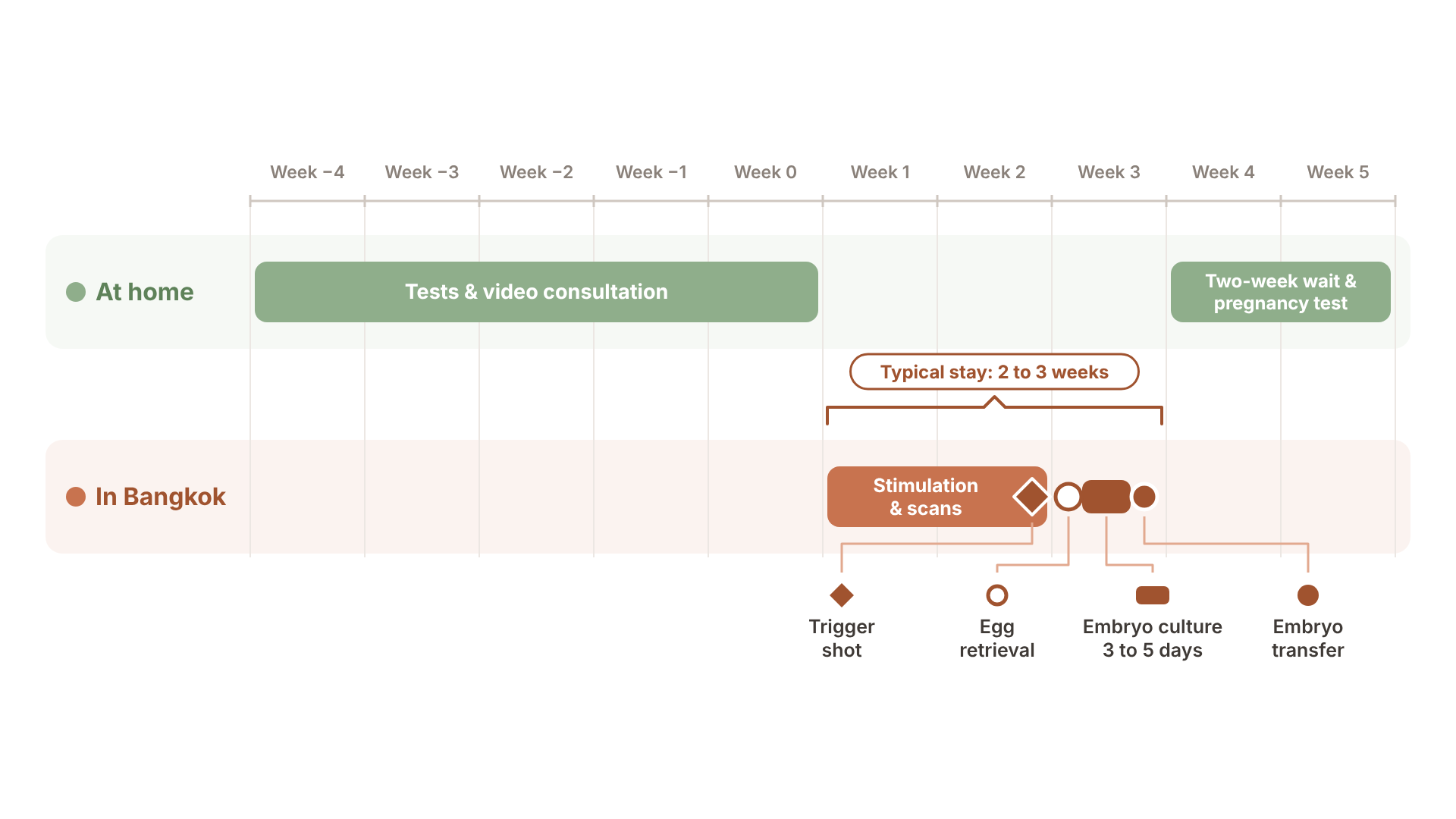
Most of an IVF cycle happens at home. The part that needs you in Bangkok is usually two to three weeks.
Timeline showing which IVF cycle stages happen at home and which happen in Bangkok, with a typical Bangkok stay of two to three weeks.
Before Week 1: Tests, Consultation and Planning
Most preparation happens before you travel, and much of it can be done with a doctor or lab at home. Typical pre-cycle tests include hormone blood tests such as AMH, infectious disease screening, a pelvic ultrasound and a semen analysis. The full list is in our guide on what to prepare before treatment.
Once your results are in, you have a video consultation with one of our doctors to agree on your protocol and likely start date. Some patients take birth control pills for one to three weeks beforehand to time the start of their cycle, so this stage can begin a month or two before your trip.
Weeks 1 to 2: Ovarian Stimulation and Monitoring
Stimulation usually lasts 8 to 14 days, according to the ASRM's patient guide to assisted reproduction. You give yourself daily hormone injections to help several eggs mature at once, with scans and blood tests every few days to track follicle growth.
How long this takes depends on how your ovaries respond, so it is the stage where your IVF schedule is most likely to shift by a few days.
Many patients start their injections at home under a local doctor's guidance and arrive in Bangkok around day 5 or 6 of stimulation, when monitoring becomes more frequent. We confirm your arrival day at your consultation.
Weeks 2 to 3: Trigger Shot, Egg Retrieval and Fertilization
When your follicles reach the right size, you take a trigger injection, and egg retrieval is scheduled 34 to 36 hours later. The retrieval itself is short and done under anesthesia, and your partner's sample is collected the same day.
Fertilization takes place in our lab, where embryos are cultured for 3 to 5 days while our embryologists track their development. You receive updates on how many eggs are fertilized and how the embryos are progressing.
Week 3: Embryo Transfer, Fresh or Frozen
In a fresh cycle, embryo transfer takes place 3 or 5 days after retrieval. If embryos are frozen instead, the transfer moves to a later cycle. That happens when you choose genetic testing, when your ovaries respond very strongly, or when the uterine lining isn't ready. A frozen embryo transfer (FET) is then timed to when your body is prepared.
Weeks 4 to 5: The Two-Week Wait and Pregnancy Test
A blood or urine pregnancy test follows about 10 to 14 days after embryo transfer. Most international patients fly home a few days after transfer and take a blood test at a local clinic or lab, then share the result with our team so we can advise on next steps.
How Long Do International Patients Need to Stay in Bangkok?
For a fresh cycle, plan on two to three weeks in Bangkok. Because pre-cycle testing can be arranged at home, your time here covers monitoring, retrieval and transfer. How long you stay depends on which path your cycle follows:
| Pathway | Time in Bangkok | Trips |
|---|---|---|
| Fresh cycle | 2 to 3 weeks | One |
| Freeze all embryos, transfer later | About 2 weeks, then about 5 to 7 days for the transfer | Two |
| Frozen embryo transfer only | About 5 to 7 days | One |
These pathways match the OPU & Embryo Culture and FET packages on our packages page. Our patient services team can arrange accommodation, airport transfers and translation support for the length of your stay.
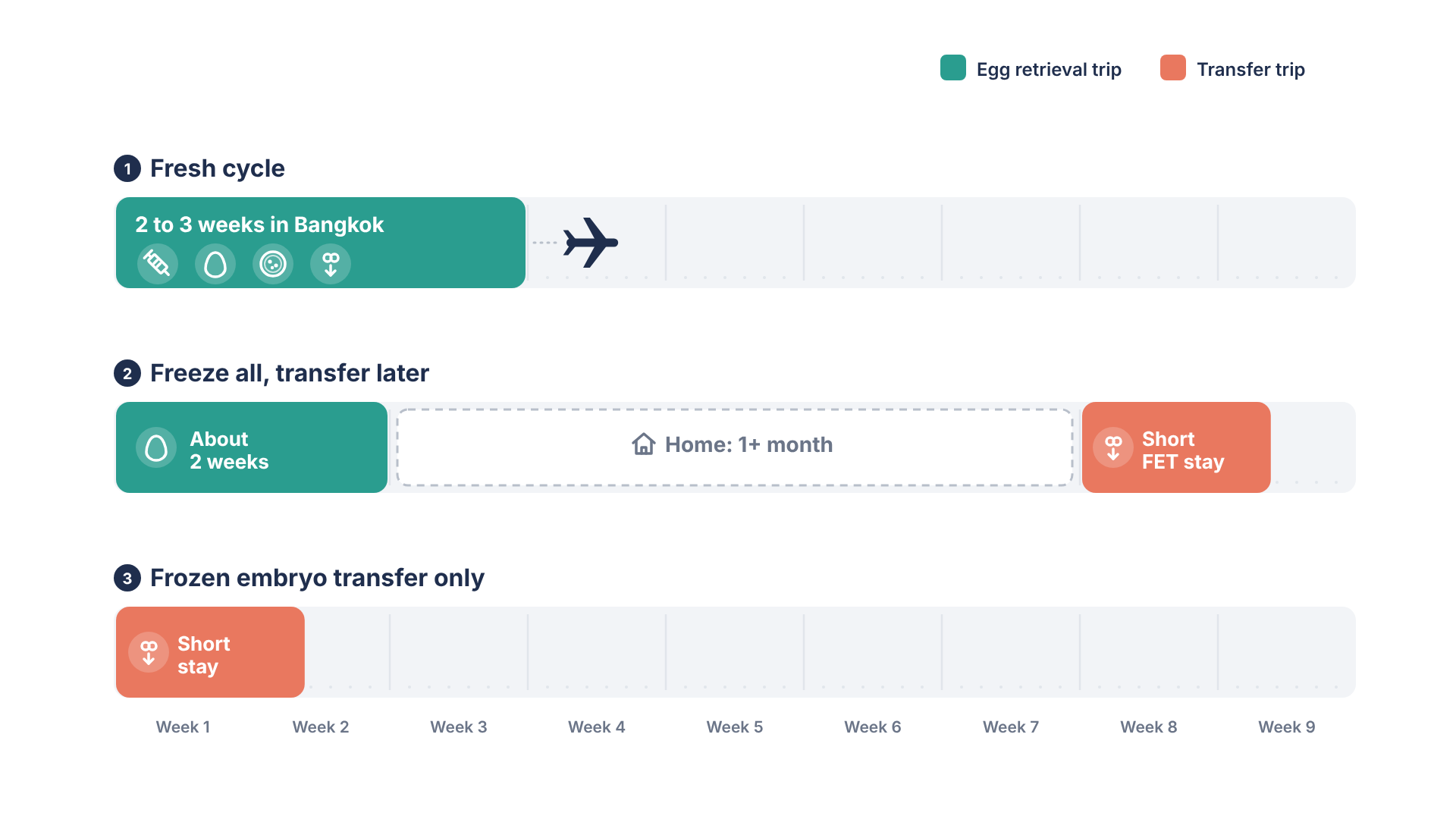
How long you stay depends on which pathway your cycle follows. A freeze-all plan splits your time into two shorter trips.
Comparison of Bangkok stay lengths for a fresh IVF cycle, a freeze-all cycle with later transfer, and a frozen embryo transfer only.
What Can Make an IVF Cycle Take Longer?
The week-by-week IVF timeline describes the typical case, not a guarantee. These situations most often stretch it:
- Slower response to stimulation. You need more injection days before the trigger.
- A cyst or unready lining at the baseline scan. The start of the cycle is postponed.
- A very strong response. All embryos are frozen and transferred in a later cycle to reduce the risk of ovarian hyperstimulation syndrome.
- PGT-A genetic testing. Results take time, so transfer moves to a later cycle.
- Cycle cancellation. Rarely, a poor response means stopping and starting again.
In our experience, the most common reason is simply that stimulation takes a few days longer than expected. That is why we advise booking a flexible return ticket rather than a fixed date.
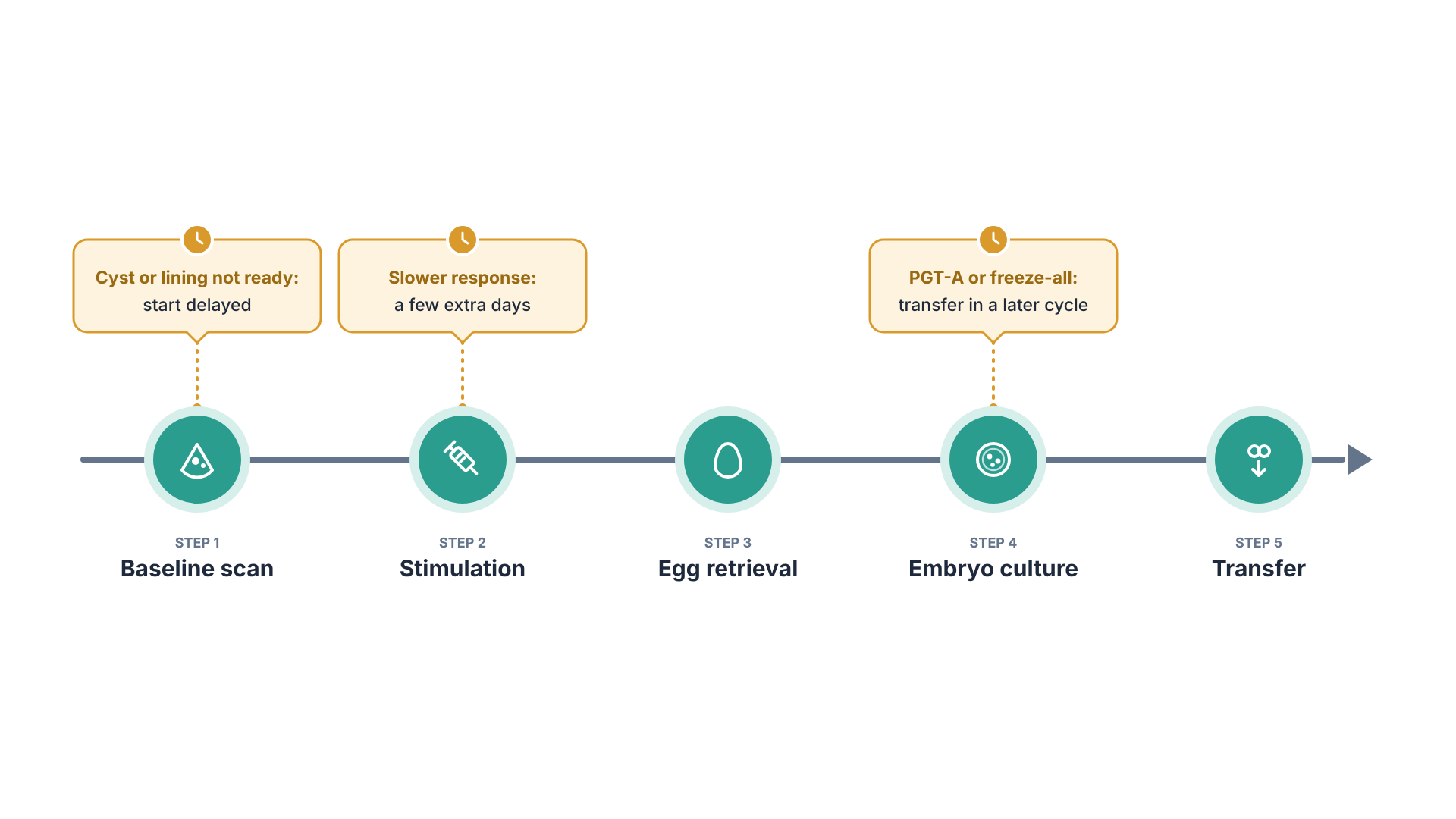
Most timeline changes happen at three points, and none of them means the cycle has gone wrong.
IVF process line showing the three stages where a cycle timeline most often extends: baseline scan, stimulation and embryo culture.
If you are planning beyond a single cycle, our article on how many IVF cycles most people need covers the bigger picture.
Planning Your Dates: A Simple Checklist
- Complete pre-cycle tests at home before booking flights.
- Plan your trip around your expected period start date.
- Allow two to three weeks in Bangkok for a fresh cycle.
- Book a flexible return ticket.
- Arrange a local lab for your pregnancy test.
- Decide early whether you are likely to choose PGT-A, since it usually means two trips.
If you would like help matching these dates to your own cycle, the patient services team at Lifespan Birth can talk you through the timing before you book anything.